The Honest Placebo: Why Ritual Heals Even When You Know It's Symbolic
Oct 06, 2026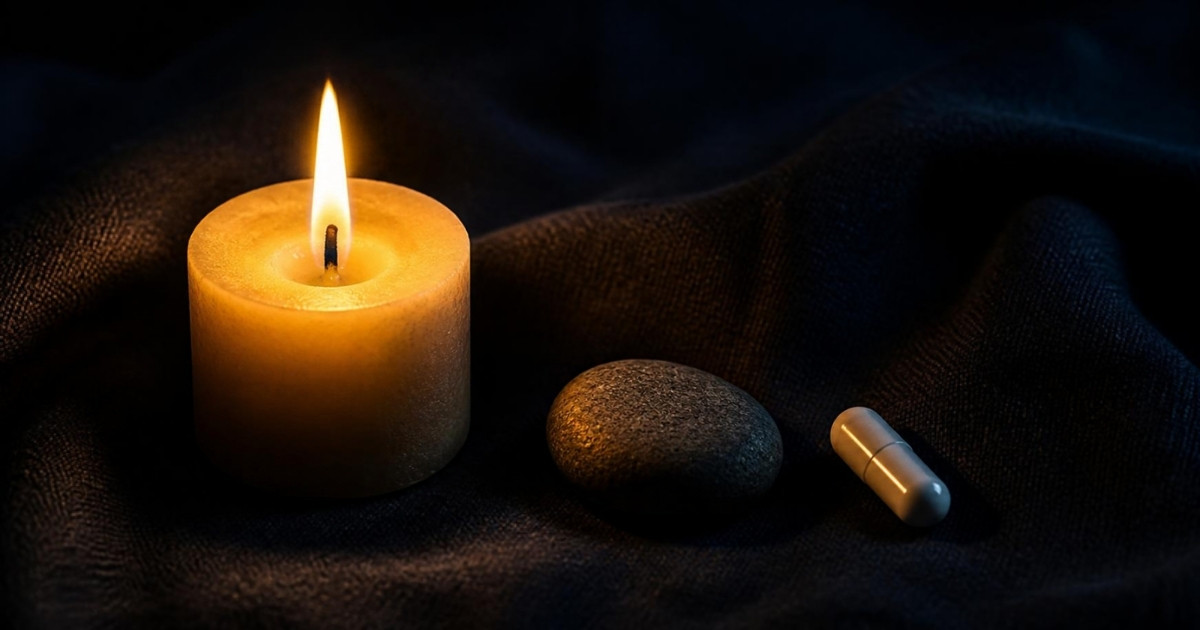
In 2010, Ted Kaptchuk and his team at Harvard did something that should have been impossible. They gave 80 people with irritable bowel syndrome either nothing or a bottle of pills clearly labelled "placebo." Patients were told the truth: these pills contain no medicine. Take them twice a day anyway.
After three weeks, 59 percent of the placebo group reported adequate symptom relief, compared with 35 percent of the untreated group (Harvard Medical School). Kaptchuk told participants they did not even need to believe in the placebo effect. They just had to take the pills.
That result has since been replicated across chronic pain, fatigue, allergic rhinitis and more. Meta-analyses of these "open-label placebo" trials find meaningful effects, strongest in clinical populations and on self-reported outcomes, with the usual caveats about small trials. I want to sit with what this means, because it says something important about ritual, healing and the work I do.
The mechanism is the ritual
If the pill contains nothing and the patient knows it contains nothing, what is doing the work?
The best current answer is the whole act of care. A clinician who listens, a regular practice, an object that marks intention, the body's learned association between taking something and feeling better. Kaptchuk has spent years arguing that placebo effects are better described as the effects of the healing ritual itself. The sugar is incidental. The ceremony is the active ingredient.
Expectancy plays a role, and so does conditioning. Years of swallowing pills that work have trained the body to begin regulating when a pill goes in. Open-label placebos seem to borrow that trained response without requiring any deception.
Ritual, stripped of superstition
This is where I find the research genuinely liberating for anyone who works with ritual, trance or ceremony.
For centuries, rationalists dismissed ritual as superstition: if the incense has no chemical effect on your liver, the ceremony is empty. Open-label placebo research suggests a more interesting position. A ritual can be fully transparent, fully understood as symbolic, and still change physiology. The candle can stay a candle. What counts is showing up, performing the act with attention and letting your nervous system respond to the frame.
Every contemplative tradition knew this. The rosary, the mala, the tea ceremony, the bow before the cushion. These are structured acts that tell the body: we are entering a different mode now. Hypnosis formalises the same principle. An induction is a ritual that announces a shift and then delivers one.
Why this matters for pleasure
I see the same mechanism daily in erotic work. A couple who light a candle, put their phones in another room and speak a short agreement before touching are performing an open-label ritual. Nobody thinks the candle causes arousal. The ritual tells two nervous systems that this time is different, and bodies respond to that signal.
The same applies to aftercare, to a collar placed with intention, to the counting down at the end of a trance. Each is honest. Each is effective. The effect lives in the frame.
Where to stay sceptical
Open-label placebos belong alongside medical care. Effects tend to be largest on subjective measures like pain and fatigue, and smaller or absent on hard biological markers. They work as an adjunct to treatment. Anyone selling a ritual as an alternative to treating cancer is exploiting the very trust that makes ritual work.
Held within those limits, the research offers a mature spirituality something precious: permission to practise ritual without pretending, and evidence that the pretending was never what made it work.
A ritual you can try
Choose a small object you can carry: a stone, a ring, a cord. For one week, every evening, hold it, take three slow breaths and say one sentence describing how you want to feel tomorrow. Tell yourself the truth while you do it: this object is a reminder, nothing more. Notice what changes anyway.
To work with ritual and suggestion yourself, explore the free Self-Hypnosis Course or browse the recordings in the Hypnosis Library.
Related reading
- The Prediction Machine: Why Hypnosis Works, and What Maya Got Right
- How Ritual Enhances Erotic and Emotional Plasticity
- Pleasure Rituals Across Cultures
Sources
- Kaptchuk, T. J., et al. (2010). Placebos without deception: a randomized controlled trial in irritable bowel syndrome. PLoS ONE, 5(12). Harvard summary
- von Wernsdorff, M., Loef, M., Tuschen-Caffier, B., & Schmidt, S. (2021). Effects of open-label placebos in clinical trials: a systematic review and meta-analysis. Scientific Reports, 11.
- Kaptchuk, T. J. (2002). The placebo effect in alternative medicine: can the performance of a healing ritual have clinical significance? Annals of Internal Medicine, 136(11).
Stay connected with news and updates!
Join our mailing list to receive the latest news and updates from our team.
Don't worry, your information will not be shared.
We hate SPAM. We will never sell your information, for any reason.