We Are Closer Than We Think: What Brains in Sync Reveal About Intimacy
Oct 03, 2026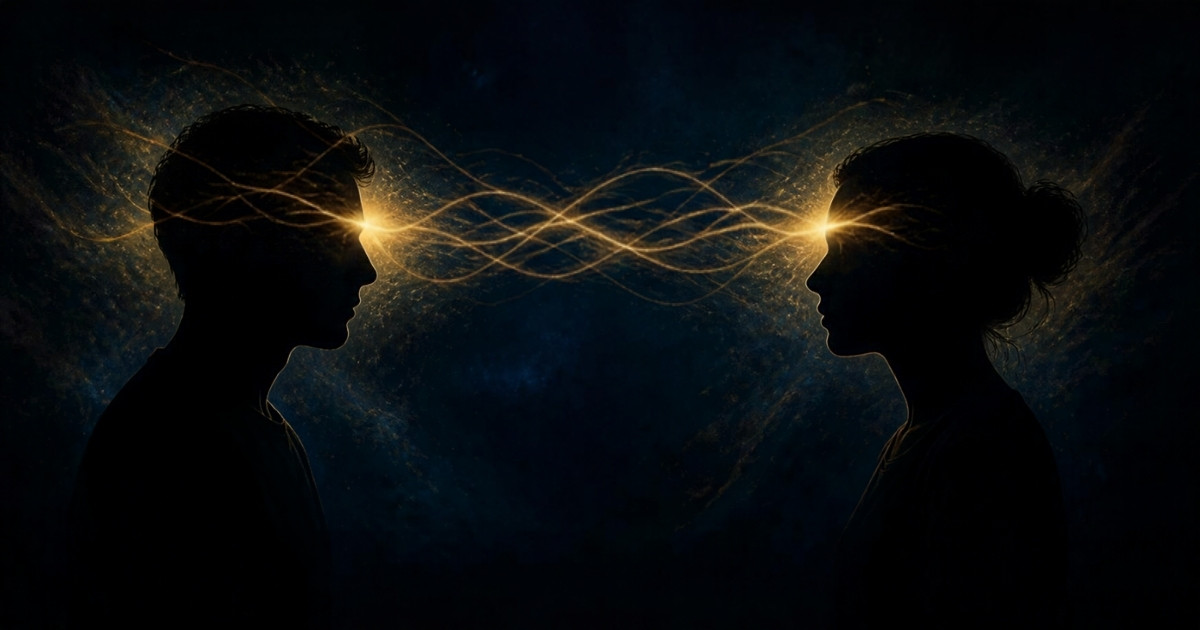
The Upanishads compressed an entire metaphysics into three syllables: tat tvam asi, "you are that." The sage Uddalaka repeats it to his son nine times in the sixth chapter of the Chandogya Upanishad, each time with a new image: rivers that forget their names in the ocean, salt that disappears into water yet flavours every drop. The claim is radical. The boundary you feel around yourself is real as an experience and provisional as a fact.
For most of modern history, science sided firmly with the boundary. One skull, one brain, one mind. Then, around the turn of the century, neuroscientists started recording two brains at once, and the picture got interesting.
Two brains, one rhythm
The method is called hyperscanning: EEG caps, fNIRS headbands or paired scanners recording people while they interact. The early theoretical case came from Uri Hasson and colleagues, who argued in 2012 that communication works through brain-to-brain coupling, where the neural activity of a speaker and a listener become temporally aligned.
The data since then are striking. In a 2017 study published in Current Biology, Suzanne Dikker's team put portable EEG on a class of high school students for a semester. The more the students' brainwaves synchronised with each other during a lesson, the more engaged they reported being, and students who felt closer to each other showed more synchrony when they had spent time face to face before class.
The study I return to most often is smaller and more intimate. In 2018, Pavel Goldstein and colleagues recorded 22 romantic couples while the woman received mild heat pain. When her partner held her hand, the couple's brainwaves coupled most strongly in the alpha-mu band, the coupling tracked how much her pain eased, and the partner's empathy predicted how strongly the two brains synchronised. When touch was taken away, the coupling dropped (Neuroscience News summary of Goldstein et al., PNAS, 2018).
Read that again with a facilitator's eyes. Presence has a frequency. Attention, given through the hand, becomes measurable in someone else's cortex, and their nervous system uses it to modulate pain.
Where the science stops
I promised you sharp, so here is the honest boundary. Synchrony between brains can arise for boring reasons: two people hearing the same sound, moving at the same tempo, breathing in the same room. Antonia Hamilton made this point in a widely cited 2021 commentary in Neuron titled "Hyperscanning: beyond the hype." Her warning is that correlation between brains is easy to find and hard to interpret, and the field needs designs that separate genuine interaction from shared stimuli.
So the data support a modest, powerful claim: when two people attend to each other, their neural rhythms align, and that alignment tracks things that matter, like engagement, rapport and relief. The data say nothing about telepathy, fused souls or a shared field beyond physics. Those may be beautiful metaphors. They remain metaphors.
Why the modest claim is still enough
Here is what moves me. Advaita Vedanta's claim was always subtler than merging egos: the separateness of egos is a surface, and underneath it awareness is one. Hyperscanning cannot test that metaphysics. It does show something that rhymes with it at the level of mechanism: the brain is built to be entrained by other brains. Our default design is permeable.
This is the thesis behind a performance project I am developing around symbiosis and synchronicity: we are closer than we think. Hypnosis is one of the oldest technologies for exploring that closeness on purpose. A good induction is a study in entrainment. Breath slows to the cadence of a voice. Attention narrows onto a shared rhythm. The hypnotist tracks micro-changes in the subject and adjusts, and the subject's system follows. Whatever is happening in two cortices during that exchange, both people feel it as resonance.
In kink, the same principle shows up as attunement. A rope top reading breath through the rope, a dominant timing a command to the exhale, a submissive dropping into the top's pace: these are synchrony practices. The research on couples suggests why they feel so intimate. Attention offered and received changes physiology on both sides.
Practice: ninety seconds of resonance
Try this with a partner tonight. Sit facing each other, one hand resting on the other's sternum. Breathe naturally for ten breaths. Then let the person receiving the touch lead: the one touching matches their rhythm without words, until neither of you is sure who is setting the pace. Notice the moment that question stops mattering.
Call it a felt experiment. You will have touched the edge of the boundary the Upanishads were pointing at, using a nervous system that science now shows was built for exactly this.
Entrainment, trance and attunement sit at the heart of the Hypnotic Kink Retreat in Tulum, November 14 to 19. All upcoming retreats are on the Events page.
Related reading
- Can You Really Be Hypnotised? What the Science Says
- What Are Conscious Power Dynamics? A Clear Guide for Curious People
- Breathwork, Music and the Ecstatic Brain
Sources
- Chandogya Upanishad, 6.8 to 6.16.
- Hasson, U. et al. (2012). Brain-to-brain coupling: a mechanism for creating and sharing a social world. Trends in Cognitive Sciences, 16(2).
- Dikker, S. et al. (2017). Brain-to-brain synchrony tracks real-world dynamic group interactions in the classroom. Current Biology, 27(9).
- Goldstein, P., Weissman-Fogel, I., Dumas, G., & Shamay-Tsoory, S. (2018). Brain-to-brain coupling during handholding is associated with pain reduction. PNAS, 115(11). Summary
- Hamilton, A. F. de C. (2021). Hyperscanning: beyond the hype. Neuron, 109(3).
Stay connected with news and updates!
Join our mailing list to receive the latest news and updates from our team.
Don't worry, your information will not be shared.
We hate SPAM. We will never sell your information, for any reason.